
The NUJ publishes the Journalist and a number of newsletters for members.
The Journalist is published six times a year and aims to give members comprehensive news and features on their industries and the union's activities. It is available here on the website and can be posted directly to members.
The Journalist reflects the work and aspirations of the union, but, importantly, it is totally independent of the union's leadership.
The editor of the magazine is elected by the union's members. This is unique in the union movement and ensures our own publication accords with the standards we expect in media organisations – that the editorial process should be independent of ownership.
For many members, the Journalist is the only regular contact they have with the union.
Our industries are in a process of fast and enormous change and it is important that we keep abreast of news, issues and trends. We welcome comments, suggestions and feature and news ideas and encourage readers to contribute to our inbox section to make points and exchange views. The best way to do this is to our email [email protected].
Christine Buckley, Editor, the Journalist.
To advertise in the Journalist, please contact Square 7 Media:

020 3283 4055
[email protected]
Media pack 2022: rates for adverts and deadlines for submission.
Find out about the Journalist editorial advisory board
2010 - 2016 Digital archive of the magazine - https://issuu.com/nujupload
Contact the Editorial board via email: [email protected]

The Journalist April May 2024
April's edition of The Journalist is now live. Download a copy or read features including on Women's football reporting and women in media online.
The Journalist February March 2024
The Post Office scandal, the high human cost of journalism in Gaza and the fights to preserve media jobs worldwide all feature in this month's edition...
Newsletter of the NUJ in Ireland.
Irish Journalist Summer 2021
A week of online events for DM 2021. Journalism: Not just busin€ss. Minding your digital footprint.
Irish Journalist Winter 2020
Newsletter of the National Union of Journalists in Ireland.

NUJ Informed is published following the meetings of the National Executive Council. It provides information on decisions made by the council and news about the union's activities, campaigns and achievements. It also reflects issues and developments in the media, publishing and PR industries.
You can print copies (in black and white or colour) and give it out in workplaces, at public or union events such as chapel and branch meetings.
NUJ Informed, Issue 35, May 2021
This month's NUJ Informed gives details of the Delegate Meeting and a week of amazing events.
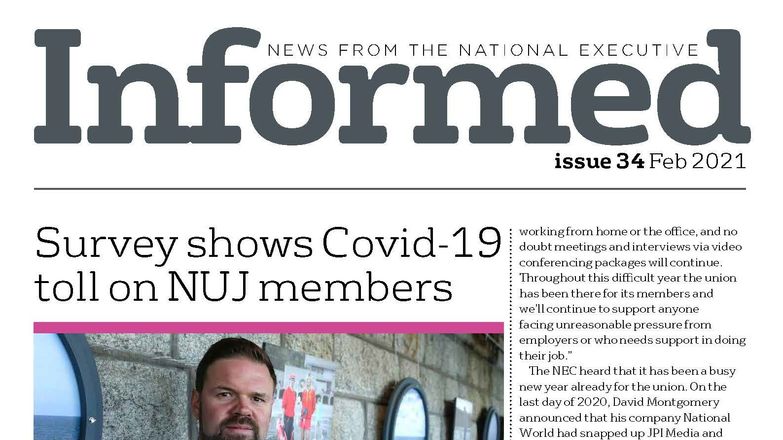
NUJ Informed, Issue 34, February 2021
All-members' survey reveals how we are all coping during the pandemic.
NUJ Branch is a special newsletter for branches to provide information and swap experiences during the Coronavirus crisis.

NUJ Branch March 2024
Launch of the #ShowUstheMoney campaign to make job recruitment fair; a call to sports bodies to make events accessible for journalists; new guidance o...
NUJ Branch January 2024
Message from Michelle Stanistreet, general secretary; Calendar of events 2024; 2024, the year newsrooms embrace AI. Reuters Institute report; Dispatch...